Sikun Guo

郭司坤

PhD Candidate in Computer Science, University of Virginia

RealAI Lab, University of Virginia · Advisor: Prof. Aidong Zhang · Charlottesville, VA

Research areas: LLM reasoning, knowledge recruitment and in-context learning, inference-time learning, graph neural networks, AI for Science, and autonomous AI research systems.

LLM reasoning · in-context learning · inference-time learning · AI for Science

Studying how language models reason and improve scientific discovery

My research asks how large language models can reason more reliably in scientific settings. I study in-context learning and inference-time optimization so foundation models can better generate, critique, and refine research ideas and hypotheses. The broader goal is to make AI systems more capable scientific collaborators: grounded, inspectable, and useful in real research workflows.

At a glance

Current position, research agenda, and recent work

Affiliation
RealAI Lab, University of Virginia
Research areas

Reasoning with large language models

In-context learning and model knowledge use

Inference-time learning for research ideation

Foundation models for scientific discovery

Graph neural networks and structured scientific knowledge

Recent work
KDD 2026 · IEEE ICDM 2025 Best Paper Award · Bioinformatics 2025 · EMNLP 2025 · IJCAI 2025 · SDM 2025 · IEEE BigData 2024

Research agenda

One research problem, several technical fronts

I work on a single underlying question: how can foundation models reason more reliably with the information available to them? That question appears in different forms—curiosity-driven ideation, inference-time optimization, truthfulness evaluation, and graph-based scientific modeling—but the agenda is consistent.

Model knowledge use

How can language models use available information more reliably when generating scientific ideas, hypotheses, and answers?

In-context learning

What makes examples, questions, and context activate better scientific reasoning from the same underlying model?

Inference-time learning

How far can adversarial feedback or reinforcement learning improve ideation, critique, and reasoning quality at test time?

Evaluation for scientific discovery

What makes model-generated ideas, hypotheses, and scientific claims trustworthy, checkable, and worth a researcher’s time?

Short bio

I am Sikun Guo (郭司坤), a PhD Candidate in Computer Science at the University of Virginia in the RealAI Lab, advised by Prof. Aidong Zhang. My research studies reasoning with large language models, theories of in-context learning, inference-time learning, and foundation models for scientific discovery. Recent work includes curiosity-driven questioning for research ideation, inference-time adversarial and reinforcement learning for idea optimization, truthfulness evaluation for scientific hypotheses, and graph-based biomedical discovery. Outside research, I follow financial markets and trading, play table tennis, sing, and enjoy road trips.

Selected publications

Recent papers

A representative slice of the research program, spanning curiosity-driven ideation, inference-time learning, scientific reasoning evaluation, and graph-based discovery.

Ideation methods 2026

Curiosity-Driven Questioning for Engine-Agnostic LLM Research Ideation

Sikun Guo, Di Wang, Xiaohan Fan, Albert Huang and Aidong Zhang

KDD 2026

Studies whether curiosity-oriented questioning can make research ideation with language models more exploratory, engine-agnostic, and practically useful. The method emphasizes question generation, filtering, and clarity scoring before ideas are handed to downstream ideation engines.
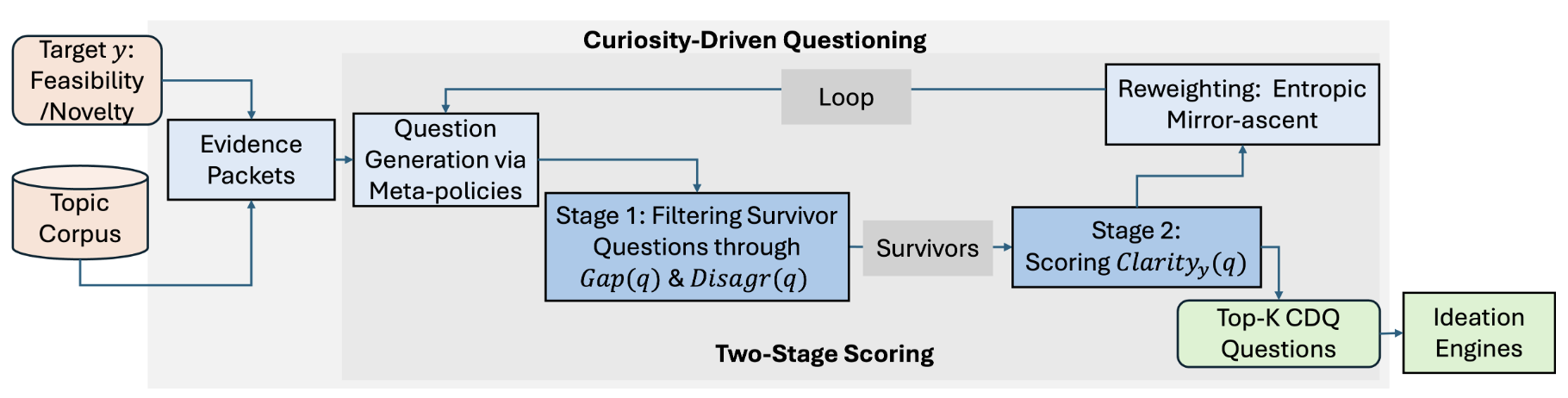
Curiosity-driven questioning pipeline with evidence packets, question generation, filtering through gap and disagreement, clarity scoring, and top-k question selection for ideation engines.
Inference-time learning 2026

InfRL: Inference-time Reinforcement Learning for Research Idea Optimization

Sikun Guo, Amir Hassan Shariatmadari, Jiuqi Wang, Albert Huang, Stefan Bekiranov, Shangtong Zhang and Aidong Zhang

KDD 2026

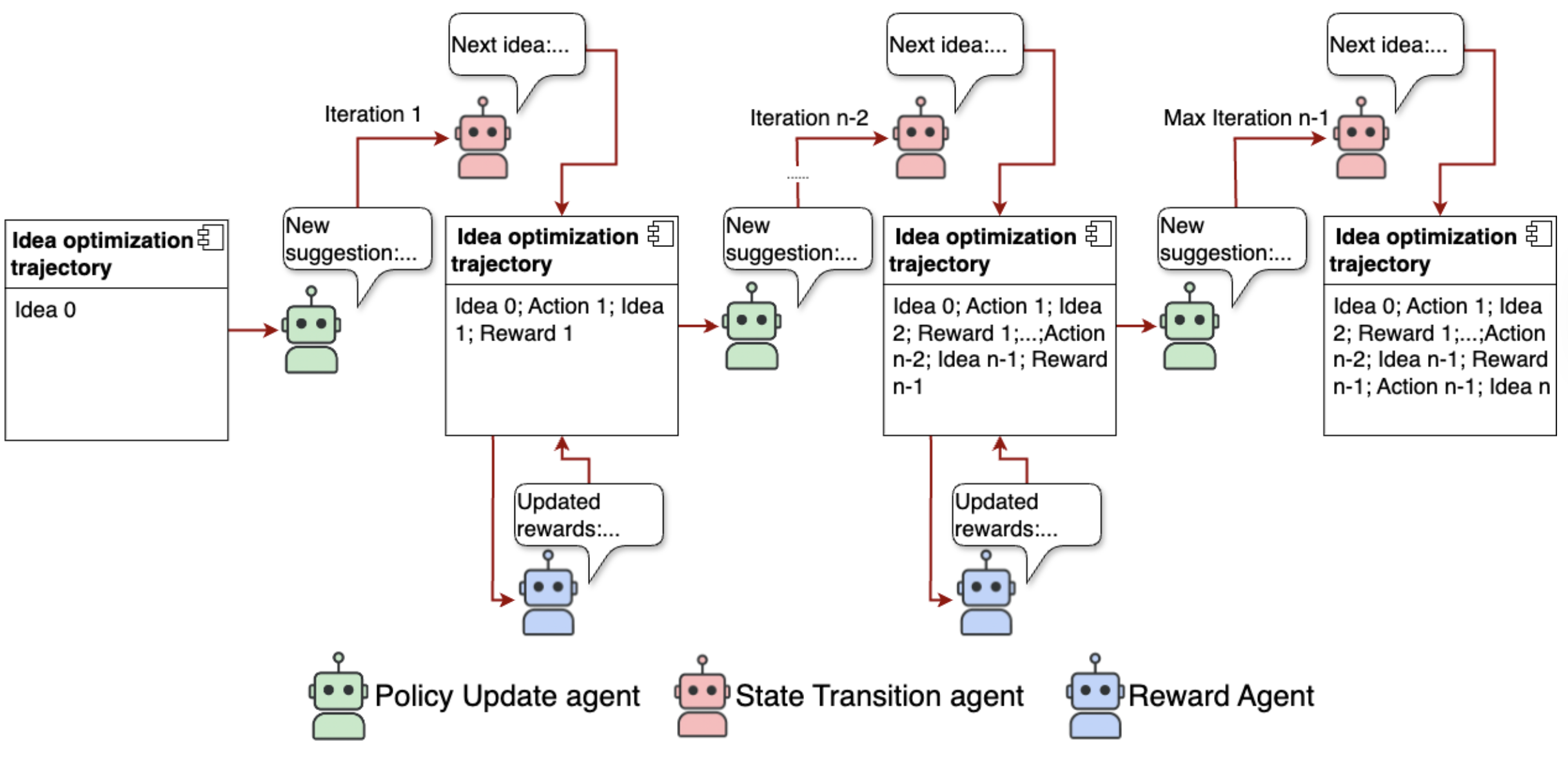
Explores inference-time reinforcement learning as a way to optimize the quality of model-generated research ideas without relying only on larger base models. The project frames idea improvement as a trajectory with actions, rewards, and iterative policy updates at test time.

InfRL figure showing idea optimization trajectory, state transition agent, policy update agent, and reward agent across multiple iterations.
Biomedical hypothesis generation 2025

HyHG: A Temporal Hypergraph Contrastive Learning Framework for Biomedical Hypothesis Generation

Amir Hassan Shariatmadari, Sikun Guo, Nathan C. Sheffield, Aidong Zhang and Kishlay Jha

IEEE ICDM 2025

ICDM 2025 Best Paper Award

HyHG models biomedical hypothesis generation with a temporal hypergraph view of evolving scientific concepts, allowing the system to capture higher-order relations that ordinary pairwise graphs miss. The paper received the ICDM 2025 Best Paper Award, making it a particularly visible result in the structured-scientific-discovery line of work.

Inference-time learning 2025

InfAL: Inference Time Adversarial Learning for Improving Research Ideation

Sikun Guo, Amir Hassan Shariatmadari, Peng Wang, Albert Huang and Aidong Zhang

Findings of EMNLP 2025

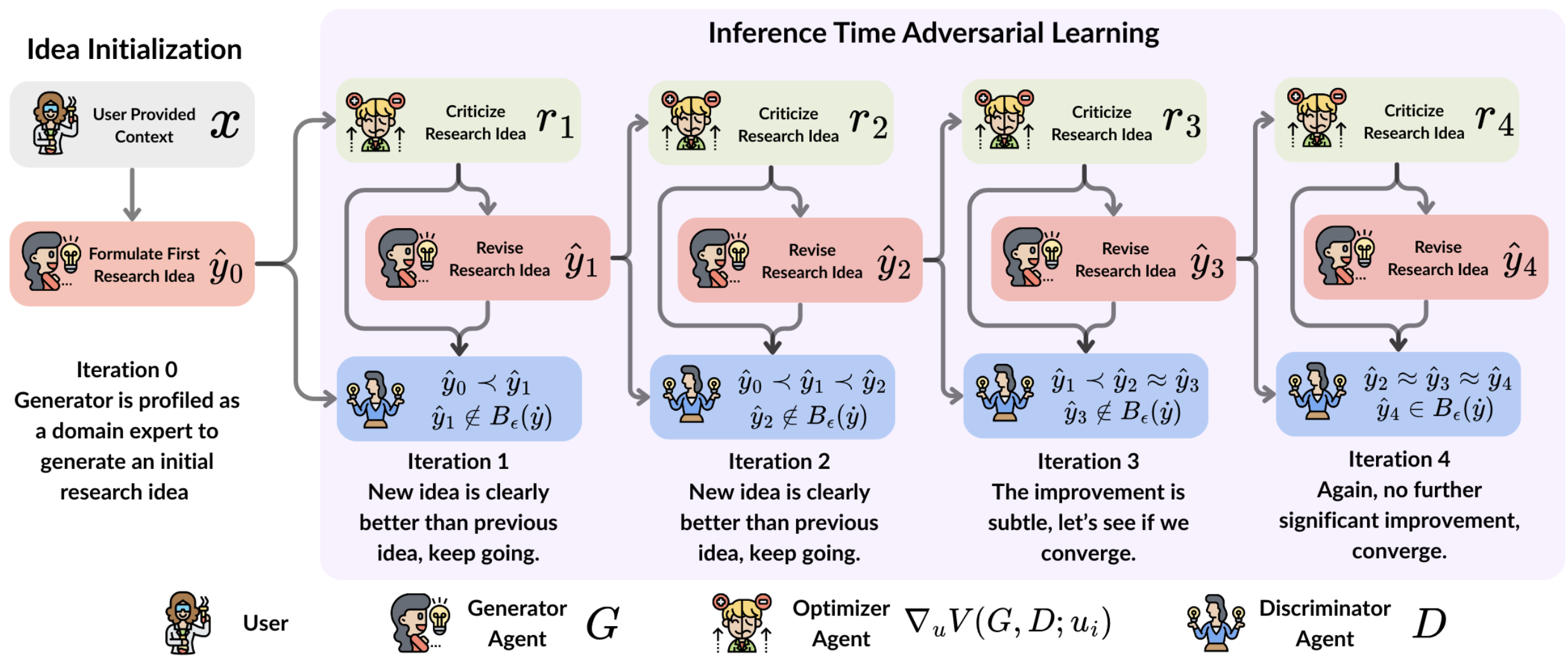
InfAL studies how adversarial learning at inference time can improve the quality of model-generated research ideas without changing the base model weights. The paper pushes research ideation beyond prompt engineering toward explicitly optimized test-time behavior.

InfAL pipeline showing initial idea generation followed by iterative critique, revision, and discriminator-guided improvement across multiple steps.
Benchmark design 2025

IdeaBench: Benchmarking Large Language Models for Research Idea Generation

Sikun Guo, Amir Hassan Shariatmadari, Guangzhi Xiong, Albert Huang, Myles Kim, Corey Williams, Stefan Bekiranov and Aidong Zhang

KDD 2025

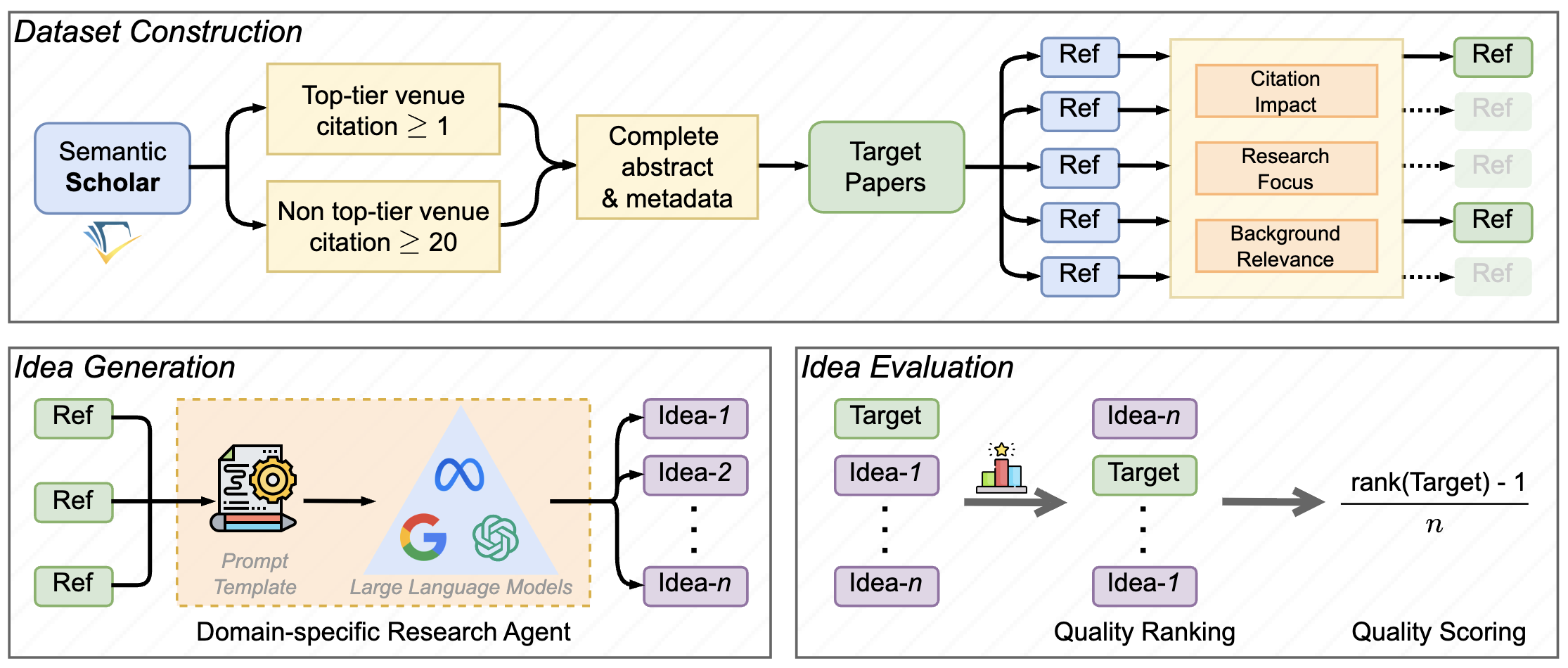
IdeaBench introduces a benchmark and evaluation framework for LLM-based research idea generation. The core contribution is not only a dataset, but also a way to measure whether generated ideas are insightful, plausible, and meaningfully distinct rather than merely well phrased.

IdeaBench pipeline showing dataset construction from Semantic Scholar, idea generation with research agents, and evaluation by quality ranking.

Industry experience

Autoscience Institute · Summer 2025

Automated scientific ideation rating with LLMs by building an agentic evaluation system for automatic scientific ideation rating.

This internship reflects the applied side of my work: turning model-centric research ideas into practical scientific-evaluation systems.

Community service

Scholarly reviewing and field participation

Reviewer: NeurIPS 2026, KDD 2026, ICDM 2025, KDD 2025

Service matters to me because it sharpens taste, exposes emerging directions early, and keeps me engaged with the standards by which the field evaluates new work.

Systems

OpenClaw: designing an operating system for AI agent organizations

OpenClaw is where I turn ideas about long-horizon reasoning, coordination, and memory into an actual system. The operating-system design is organized around three principles: departmentalized agents instead of one monolithic assistant, layered external memory instead of hidden context, and self-evolution through explicit write-back to skills, docs, and workspace artifacts. In practice, the system learns from user–agent interaction and from the outcomes of agent–agent collaboration, which makes it feel much closer to an in-context reinforcement-learning loop than to a static prompt wrapper. I include it here because it reflects a style of work I care about: turning research questions into concrete, inspectable systems.

Departmentalization

My system is designed around specialized departments rather than a single generalist assistant. Research, coding, job-hunting, and other roles can be separated, coordinated, and supervised with explicit boundaries.

Layered memory

The memory system is deliberately externalized across daily notes, curated long-term memory, skills, docs, and workspace files so that context survives session resets and remains inspectable by both humans and agents.

Self-evolution

The operating system learns from user–agent interaction and from the outcomes of agent–agent collaboration. By writing those lessons back into prompts, skills, docs, and workflows, my system behaves much closer to an in-context reinforcement-learning loop than to a static agent shell.

Operator goals · oversight approvals · feedback Departmentalized agent organization main agent + specialist departments research · coding · job hunting · domain work separate mandates, shared coordination and supervision Execution layer browser · tools · messages gateway · sessions · nodes Layered external memory daily notes · long-term memory · skills · docs workspace artifacts · operating conventions agents read from it and write back into it Self-evolution learn from user-agent and agent-agent outcomes write back into skills and docs
My system treats agent organizations as an operating-system problem: human goals are routed through specialized departments, departments act through an execution layer, memory is externalized into editable layers, and the system improves by learning from user–agent and agent–agent interaction outcomes and writing those lessons back into skills, docs, and workflows.

Long-term direction

My long-term goal is to help build autonomous AI research systems that make serious research more widely accessible. High-quality research capacity is still concentrated in a relatively small number of institutions and teams. If AI systems can better use learned knowledge, reason more reliably, and interact productively with structured scientific evidence, they can broaden who gets to do meaningful research and at what scale.

Recent updates

Selected updates

2026

Curiosity-Driven Questioning and InfRL extend the research-ideation line at KDD 2026.

2026

Serving as Teaching Assistant for Artificial Intelligence (CS4710) at UVA.

2025

Co-authored HyHG received the ICDM 2025 Best Paper Award.

2025

Completed a Research Scientist internship at Autoscience Institute focused on automatic scientific ideation rating.

2025

IdeaBench, InfAL, and hypothesis-generation work appeared at KDD, EMNLP, IJCAI, SDM, and Bioinformatics venues.

Global reach

United States Taiwan Hong Kong China